
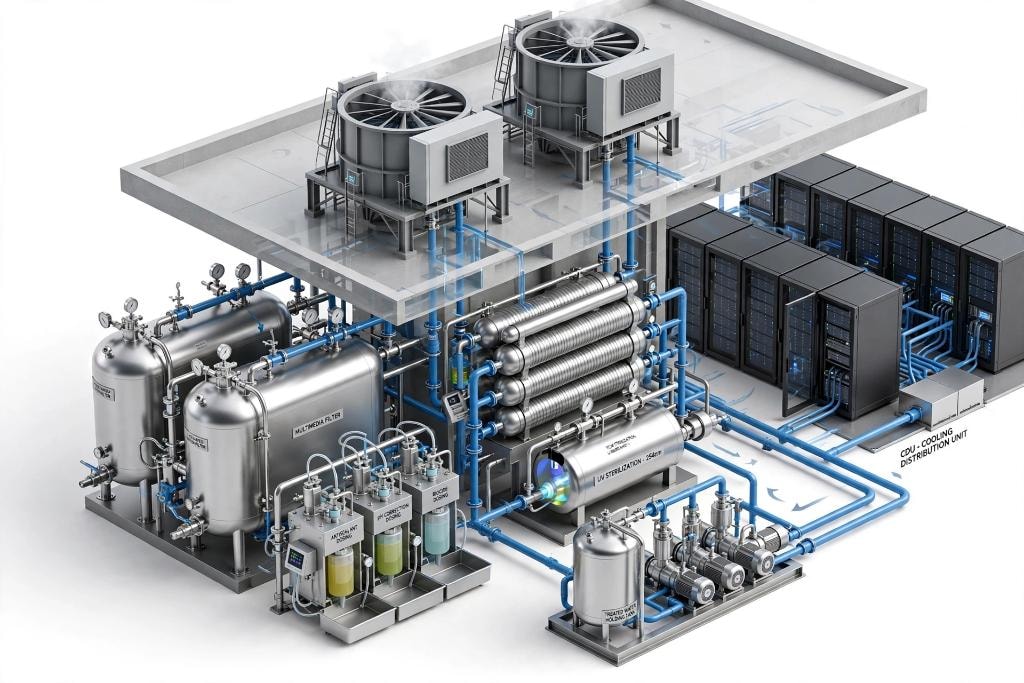
Data centres are thirsty. A 100 MW hyperscale facility can consume millions of litres of water a year for cooling if its water treatment is not optimised. In 2026, with AI workloads pushing chip temperatures above 80°C, water treatment is no longer a utility — it is a critical uptime and ESG strategy.
In India, where many operators are now shifting to air-cooled chillers to reduce water consumption, the quality of water in the closed loop becomes even more critical. This guide breaks down everything you need to know — from the five treatment stages to ROI calculations and a buyer's checklist for Mumbai and beyond.
Why Do Data Centres Need Advanced Water Treatment?
Untreated water destroys cooling efficiency. The four core problems are:
- Scaling: Calcium and magnesium deposits on chillers and CDUs reduce heat transfer by up to 30%.
- Corrosion: Dissolved oxygen and low pH eat through stainless steel pipes and server cold plates.
- Biofouling: Bacteria and algae form biofilm in cooling towers, leading to Legionella risk and system blockages.
- Downtime: A single fouled heat exchanger can trigger a thermal shutdown — the most expensive outcome of all.
The goal is simple: achieve ultra-pure, chemically stable water for a 99.999% uptime cooling loop.
The 5-Stage Water Treatment System for Modern Data Centres
This is the system shown in the 3D render above — the same configuration Aquatic Solutions engineers and supplies for data centre projects across India.
Stage 1
Pre-Filtration — Multimedia & Activated Carbon Filters
Removes suspended solids, turbidity, and chlorine from raw water or treated effluent. New plants in Malaysia like Bridge Data Centres are now built with on-site plants that take treated effluent and polish it for cooling reuse — a model increasingly relevant for water-scarce Indian cities.
Stage 2
Reverse Osmosis (RO) — The Heart of the System
High-pressure membranes remove 98–99% of dissolved salts (TDS). This is essential for closed-loop cooling where even 50 ppm hardness can cause scaling at 45°C operating temperatures — the new standard for direct-to-chip liquid cooling pioneered by Nvidia.
Stage 3
Chemical Dosing — Antiscalant, pH Correction & Biocide
Automated dosing skids inject antiscalant (prevents silica and calcium precipitation), pH corrector (keeps water at 7.5–8.5 to prevent corrosion), and non-oxidising biocide. Sustainable alternatives are gaining traction for green-certified facilities.
Stage 4
UV Sterilisation (254 nm)
Destroys 99.99% of bacteria without adding chemicals. Mandatory for systems using reclaimed water or treated sewage effluent (TSE) as input — increasingly common in Indian data centre parks.
Stage 5
Closed-Loop Distribution & Cooling Towers
Treated water is stored in a holding tank and pumped via CDUs directly to server racks. The future? Zero-water cooling. Microsoft's new closed-loop system uses no water for cooling at all, evaporating zero litres on-site.
Open Loop vs Closed Loop vs Zero-Water: Which Is Right for You?
| System Type | Water Use | PUE Impact | Best For |
|---|---|---|---|
| Open Evaporative Tower | Very High | Low PUE | Legacy facilities with abundant water |
| Closed-Loop Chilled Water | Low | Medium | Most Indian data centres in 2026 |
| Direct-to-Chip + Zero Water | Near Zero | Higher PUE, Zero WUE | AI / GPU clusters, water-scarce regions like Mumbai, Chennai |
For India, the sweet spot in 2026 is air-cooled chillers combined with closed-loop treated water. Industry experts note this approach can reduce a 100 MW facility's water consumption to as low as a restaurant's annual use.
ROI: How Good Water Treatment Saves Crores
Energy Savings
Clean heat exchangers use 20–25% less energy — a significant reduction in PUE and electricity bills.
Water Reuse
Coupling with wastewater treatment can save 1,300 million m³ of freshwater globally and reduce municipal water costs.
Asset Life
Proper treatment increases chiller and server life from 5 to 10+ years, deferring capital expenditure.
Compliance
Meets LEED, IGBC, and Uptime Institute sustainability requirements — essential for attracting hyperscale tenants.
Checklist for Buying a Water Treatment System in India
- Test your source water TDS, hardness, and silica before specifying any system.
- Demand automation with TDS, pH, and ORP sensors plus BMS integration.
- Ask for a WUE (Water Usage Effectiveness) guarantee, not just equipment specifications.
- Ensure the AMC includes membrane autopsy and Legionella testing.
- Choose a vendor who can handle treated sewage effluent (TSE) as input for maximum sustainability.
Frequently Asked Questions
What is the best water treatment for data centre cooling?
The best system is a 4-stage configuration: Multimedia filter → RO system → Chemical dosing → UV sterilisation, feeding a closed-loop cooling circuit. This prevents scaling and biofouling while enabling water reuse.
How much water does a data centre use?
A traditional 100 MW data centre with evaporative cooling can use 1+ million litres per day. With modern air-cooled chillers and closed-loop treatment, this can be reduced by more than 90%.
Can data centres use wastewater for cooling?
Yes. The data-water symbiosis model pairs wastewater treatment plants with data centres to use polished effluent for cooling, cutting CO₂ by an estimated 84 million tonnes globally.
Need a Water Treatment System for Your Data Centre?
Aquatic Solutions designs and supplies turnkey water treatment plants for data centres across India. Get a free site assessment and system recommendation.